
What Does a Ragdoll Kitten Really Cost in 2026?
If you have ever searched “What does a Ragdoll kitten really cost?” you already know how confusing the answers can be. One page gives a tiny number. Another gives a number that makes you blink twice. Most do not explain what is included, what was done before the kitten was born, or why one kitten may be priced differently from another.
That missing explanation matters. You are not only comparing two dollar amounts. You are comparing health testing, veterinary care, time with the mother and littermates, socialization, pedigree records, written guarantees, and the breeder’s support after your kitten comes home.
The short answer: There is no official nationwide price for a Ragdoll kitten. In 2026, a responsibly bred kitten from a registered cattery commonly costs several thousand dollars because programs include very different levels of care. At Moonseed Ragdolls, most kittens are $4,500–$4,800. When a kitten has special pricing, we explain the reason on that kitten’s own page.
A lower fee is not automatically a red flag. Rescues, shelters, retired adults, and older kittens may all be priced very differently from a young pedigreed kitten. What matters is that the explanation makes sense and can be verified. There is such thing as a price that is "too good too be true".

What Does a Ragdoll Kitten Really Cost in 2026?
A photo cannot show you everything behind a price. Two fluffy, blue-eyed kittens may look similar online while coming from completely different situations.
Sometimes the listing is not real. Scammers often use stolen photos and an unusually low price to make families act quickly. Before sending money to a Ragdoll breeder, use our step-by-step guide, How to Verify a Ragdoll Breeder Is Real Before You Send Money.
Sometimes the kitten has no verifiable pedigree. A long-haired pointed cat can be lovely, but appearance alone does not prove that the cat is a pedigreed Ragdoll. Registration records and documented parents are what connect a kitten to the breed.
Sometimes important care is not included. Parent testing, veterinary examinations, vaccines, parasite prevention, microchipping, spay or neuter surgery, and extra weeks of care all cost real money. If a breeder leaves several of those steps to the buyer, the advertised price may be lower even though the family’s total cost is not.
The kindest way to compare prices is to slow down and ask what the number includes. A responsible breeder should be comfortable answering that question without pressure or defensiveness.
What Moonseed’s Ragdoll kitten cost includes
At Moonseed Ragdolls, every kitten receives the same core care. A kitten with special pricing does not receive a smaller veterinary package, a shorter guarantee, or less support. A special price that is less or more than our average $4500 -$4800 usually involves factors such as: age, pedigree and lineage, award status, health, and personality.
Before a litter is planned
Our breeding cats receive broad DNA testing through Optimal Selection™ Advanced – Feline, including the Ragdoll-associated HCM variant, PKD and many other inherited conditions, along with blood-type information. We also use FeLV/FIV testing, pathogen screening when appropriate, pedigree documentation, and ISAG 2020 DNA profiles with parentage verification. These steps begin long before there is a kitten to photograph.
While the kittens are growing
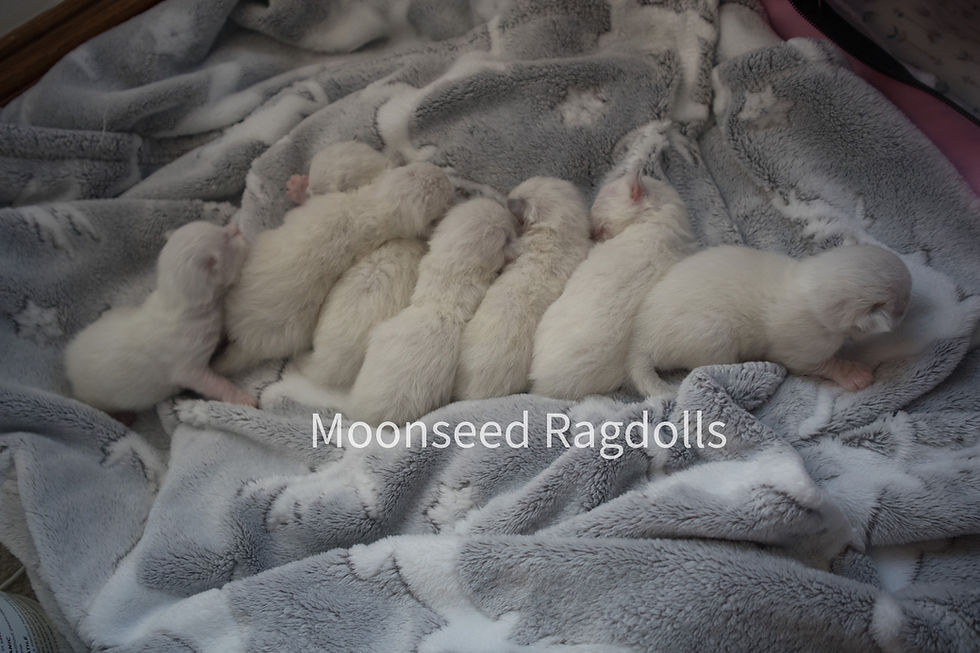
Our kittens stay with their mother and littermates until about 14 weeks of age. During that time they are raised in our home, handled daily, and introduced to normal family life with children, adults, household sounds, and our dogs. They receive two to three veterinary wellness examinations, age-appropriate FVRCP vaccines, deworming, parasite prevention, rabies vaccination when age appropriate, a microchip, and spay or neuter surgery before go-home.
What goes home with the kitten. Every Moonseed kitten is protected by written contract terms that include a 5-year genetic health guarantee, a 3-year HCM guarantee, and a 2-year FIP guarantee.
Families also receive 30 days of Trupanion coverage, A microchip with free registration, a familiar-scent blanket, toys, our Moonseed Go-Home Guide, a supply list with direct links, and lifetime breeder support.
You can review the details before applying on our Health Guarantee and Adoption Process pages.
Why the extra weeks matter
Those weeks are not simply extra boarding. Kittens are still learning from their mother, their littermates, and the people around them. In a study of 5,726 cats across 40 breeds, cats separated at 14 weeks or later had a lower probability of aggression toward strangers than cats separated early and a lower probability of stereotypic behavior than cats separated at 12 weeks (Ahola et al., 2017).
For us, keeping kittens until about 14 weeks is part of raising confident family companions. It also means additional food, litter, cleaning, veterinary care, space, observation, and daily socialization for every kitten.
Why health testing is more than one DNA result
Ragdolls have a known breed-associated MYBPC3 variant linked with hypertrophic cardiomyopathy, or HCM. Genetic testing is useful, but a negative result for that one variant cannot rule out every possible cause of HCM. Current veterinary cardiology guidance recommends genetic testing for Ragdolls used in breeding and says regular echocardiographic screening should still be considered even for cats that test negative for the known variant (Fuentes et al., 2020).
That is why a thoughtful health program looks at the whole cat, the whole pedigree, and ongoing veterinary screening—not only one certificate.
Five things we consider when explaining an individual kitten’s price
Our priorities are health, temperament, and the Ragdoll breed standard—in that order. Here is what that means in everyday language.
1. Health and readiness
Health is the gate, not an upgrade. A kitten should never be offered as a bargain because a breeder hopes a family will overlook an unresolved medical concern. If a kitten is not healthy and ready for placement, the placement should pause. Every Moonseed kitten receives the same core veterinary care and written guarantees, regardless of price.
2. Temperament and home fit
Temperament matters deeply to us because families usually fall in love with Ragdolls for their gentle, affectionate companionship. TICA describes the breed as affectionate, relaxed, loving, quiet, and often delightfully floppy when cuddled (The International Cat Association [TICA], n.d.).
Kittens are still individuals. One may greet everyone at the door, while another watches for a few minutes before joining in. If a kitten is more reserved than is typical for our program, we may reduce the price and describe the kind of home where that kitten is most likely to shine.
A reserved Moonseed kitten is not a fearful kitten. It may be a thoughtful little soul who bonds deeply with a few people and prefers a calm household. For the right family, that is not a compromise. It can be the perfect match.

3. Conformation to the breed standard
Conformation means how closely a kitten matches the written Ragdoll standard, including body structure, head shape, coat quality, eye color, and the placement of markings. These details can matter for showing and breeding decisions. At Moonseed, they come after health and temperament.
4. Lineage and pedigree
Pedigree tells the story behind a kitten: the registered parents, traditional lines, championship history, and the care taken to plan generations responsibly.
Our sire, TICA Champion USAPurrs Hawthorn of Moonseed, has a 100% traditional pedigree with 97% traceability to the original Ragdoll cats associated with Ann Baker. Our pedigrees also include Grand Champion, Supreme Grand Champion, Lifetime Achievement, and international winning lines.
You do not have to take our word for it. Our breeding cats’ public pedigree links, testing information, blood types, genotypes, and FeLV/FIV status are available on our Our Ragdoll Cats page, with pedigrees linked to PawPeds.
5. Age
Older kittens are often offered at a reduced price. “Older” does not mean unwanted or lesser. It can mean fully vaccinated, already altered, past the most fragile baby stage, and mature enough that the kitten’s personality is easier to understand.
For a first-time cat owner, a quieter home, or a family that would rather skip the tiny-tornado stage, an older kitten can be a wonderful choice, and sometimes the better match.
Why we explain every special price
Every available Moonseed kitten has an individual page, and every special price has an explanation.
Each available kitten's page includes date of birth, parents, color and pattern, current photos or video, personality observations, the kinds of homes we believe would be a good fit, and the price.
We do this because a number without context leaves families guessing. A lower price does not automatically mean something is being hidden, and a higher price does not automatically prove quality. Clear information helps you decide whether the kitten and the breeder are right for your family.
It also helps us place kittens thoughtfully. A family who reads, “This kitten likes to observe before joining in and would thrive in a calm home,” may recognize the companion they have been hoping to find.
A thoughtful note about adopting two kittens
Ragdolls are known for being people-oriented, and many prefer plenty of companionship. If your home is empty for long stretches, two compatible kittens may help each other settle, play, and feel secure.
Two kittens do cost more, and a pair is not automatically the right choice for every household. The best answer depends on your schedule, budget, other pets, and the personalities of the kittens. We would rather help you make a good long-term match than give you a one-size-fits-all answer.
Questions to ask any breeder about price
A price makes much more sense when you can see what supports it. These four questions will tell you a great deal:
What is included in this price, specifically?
Why is this kitten priced differently from another kitten in the same program?
What testing have the parents received, and may I review the results?
May I read the contract and health guarantee before I commit or send payment?
Notice not only the answers, but also how the breeder responds. Thoughtful questions should be welcomed.
What to budget beyond the purchase price
The purchase price is the largest single expense, but it is not the whole budget. Plan for:
Home setup. Large litter boxes, litter, food and water dishes, a sturdy carrier, scratching surfaces, a tall cat tree, toys, and grooming tools.
Your first veterinary visit. Our contract requires a wellness examination with your veterinarian within 72 hours of pickup. Your veterinarian can also review the remaining vaccine schedule and establish a long-term care plan.
Ongoing care. Quality food, litter, parasite prevention, routine examinations, dental care, grooming supplies, and enrichment.
Pet insurance. Every Moonseed kitten goes home with 30 days of Trupanion coverage. If you continue insurance, compare deductibles, exclusions, reimbursement rules, and pre-existing-condition language carefully.
Heart-health conversations. Ask your veterinarian what HCM screening plan is appropriate for your Ragdoll. Genetic testing lowers uncertainty about one known variant, but it does not replace veterinary evaluation or all future screening (Fuentes et al., 2020).
None of this is meant to make bringing home a kitten feel intimidating. A realistic budget simply lets you enjoy your new family member without being surprised by predictable expenses.
References
Ahola, M. K., Vapalahti, K., & Lohi, H. (2017). Early weaning increases aggression and stereotypic behaviour in cats. Scientific Reports, 7, Article 10412. https://doi.org/10.1038/s41598-017-11173-5
Fuentes, V. L., Abbott, J., Chetboul, V., Côté, E., Fox, P. R., Häggström, J., Kittleson, M. D., Schober, K., & Stern, J. A. (2020). ACVIM consensus statement guidelines for the classification, diagnosis, and management of cardiomyopathies in cats. Journal of Veterinary Internal Medicine, 34(3), 1062–1077. https://doi.org/10.1111/jvim.15745
The International Cat Association. (n.d.). Ragdoll. Retrieved August 16, 2026, from https://tica.org/breed/ragdoll/
Frequently asked questions
How much does a Ragdoll kitten cost in 2026?
There is no official nationwide price. A responsibly bred kitten from a registered cattery commonly costs several thousand dollars because the testing, veterinary care, age at placement, guarantees, and support vary widely. At Moonseed Ragdolls, most kittens are $4,500–$4,800, and every special price is explained on the kitten’s page.
Why are Ragdoll kittens expensive?
Responsible programs pay for parent health testing, registered pedigrees, veterinary examinations, age-appropriate vaccines, parasite prevention, microchipping, spay or neuter surgery, extended care through about 14 weeks, careful socialization, written guarantees, and long-term breeder support.
Why might one kitten cost less than another?
At Moonseed, special pricing may reflect age, temperament and home fit, conformation to the breed standard, or pedigree. Health is never a lower-priced upgrade or downgrade; every kitten receives the same core veterinary care and guarantees.
Does a discounted Ragdoll kitten mean something is wrong?
No. An older kitten or a more reserved kitten may be offered at a reduced price and still be healthy, affectionate, and beautifully suited to the right home. The important part is a clear written explanation and consistent care.
Is a $500 Ragdoll kitten real?
It could be a legitimate rescue or shelter placement, but a breeder advertising a young, registered, health-tested kitten for a few hundred dollars deserves careful verification. Confirm the breeder, parents, records, contract, and payment details before sending money.
Should I adopt two Ragdoll kittens?
Sometimes. A compatible pair can be a lovely choice when the household is away for long stretches, but two kittens also require a larger budget and twice the long-term care. The right decision depends on your home, schedule, other pets, and the kittens’ personalities.
Does color or pattern change a Ragdoll kitten’s price?
It can affect conformation and demand, but at Moonseed, health and temperament matter more than markings. We explain the reasoning behind every individual price.
Every available Moonseed kitten has an individual page with current photos or video, date of birth, parents, personality notes, suggested home fit, and a clearly explained price. You can review that information before applying.
